There’s a new era for StoryBox on the horizon. Surprisingly, it’s something I thought I’d never do, on multiple fronts, yet here we are.
What the hell are you talking about?
I switched to using Linux about two months back. I got fed up with all the crap that Microsoft is shoveling these days – bad updates, shoving ai in places where it doesn’t belong, ads in your operating system that you PAID for, tracking you across the internet, no matter what services and settings you change (yes – this is a new one – search out Windows GDID).
So I switched, and I’m never going back. My experience with Linux, so far, has been pretty much better in every way. It boots faster, apps start up faster, it doesn’t force updates on me, ever (I’ve had my windows machine reboot on me when I’m in the middle of working on something to do an update – no way to stop it).
You might ask, “Why not Apple?” The answer is simple. I don’t want to afford Apple products. They’re not expandable or upgradeable, and they sunset them far too early. I had a Macbook Pro once, that suddenly couldn’t get new OS versions, and it was only four years old. They just decided, “Nope. We want you to shell out more money.” I’m also not a fan of the OS. And have you seen the latest UI changes in the latest version of the OS? Those huge rounded corners are so space wasting and fugly, it’s impressive.
And that is why I chose Linux.
But what in the name of word count does that have to do with StoryBox?
I’ve been asked in the past if there would ever be a Mac version of StoryBox, and I always had to answer with a big “No”. It’s written in C#, and uses a UI library that is not available on the Mac. So, essentially, it was impossible.
Until I decided to switch to Linux, and discovered that the writing app landscape on Linux is in dire need of better software. You *can* get Scrivener working on Linux under Wine (which is this software that can make Windows apps work on Linux – but not all of them), but native options are few and far between, and none of them are what I would call first rate pieces of software.
I’m not talking about office style writing software – the word processor that comes with Libre Office, for instance, works great for general writing tasks, but for writing a novel in the way that StoryBox does? There are apps. They aren’t for me.
So I decided on taking a stab at porting StoryBox to Linux. However, I kind of hate straight porting, and I wanted a challenge, so I decided to not only port it to Linux, but also have versions for Apple and Windows. In addition, I chose to do it the hard way: I switched languages.
One of the things that always bugged me about StoryBox, and it’s C# underpinnings, was how long it would take to open. On my super fast machine (fastest I could get last September before the ram apocalypse ruined everything), it still takes multiple seconds even for the splash screen to show up (at least, on first load). You could also see it chug loading some of the UI, which I always kind of thought was terrible. I don’t want to see those things. It had lots of features, but it didn’t feel as zippy as I’d have liked.
Which led me to this: I’m rebuilding StoryBox in C++. From the ground up. And from the start, it runs on all Windows, Linux, and macOS. The best part? So far, startup is instant. It takes practically no time between clicking the icon to start it and the moment it appears on your screen. It’s amazing. Splash screen to hide the loading? Who needs it? Project loading? It’s near instant. It just feels so responsive in a way that the original never did. I put a million words into a single document (not how I envision anyone using StoryBox, to be honest), started typing, and did not feel any lag to speak of, despite counting the words with every keystroke. At 1.6m words, though, yeah, a little laggy.
This version of StoryBox will be backward compatible with the most recent version of StoryBox 2. All of your old files will open in the new version of StoryBox. If you don’t have the latest version of the older software, you will need to get it, just long enough to open your projects in it. It’s also currently available free on StoryBoxSoftware.com.
You won’t be able to switch a project back, though due to the internal format of the text changing. Previously, it was rtf, but the new editor component doesn’t support rtf, so it will be the version of html that it supports, which, of course, the old StoryBox won’t understand. So, back up your projects if you make the switch.
And now, the most important part of this post. The explanation of the title of this whole thing.
StoryBox, the new StoryBox, will just be called StoryBox.
Wait. That’s not it. What is it?
Oh.
Oh yeah.
StoryBox will be free. Free to use. Free to copy the source and build it yourself. Free and open source, and as liberally licensed as I am able to make it. I don’t think most writers care about the open source part, but, the price? It’ll be priced just right.
Why, though? Why make it free?
I just DON’T want to run it as a business, anymore. I don’t want to deal with having a store front. I don’t want to deal with having to do tech support on a basis where I feel obligated. I never made enough money on StoryBox to support a living. Not even close.
I’m doing this, because I want to see StoryBox out there, and I want to see it used, because I think it’s better than any of the other pieces of novel writing software I’ve tried, even Scrivener.
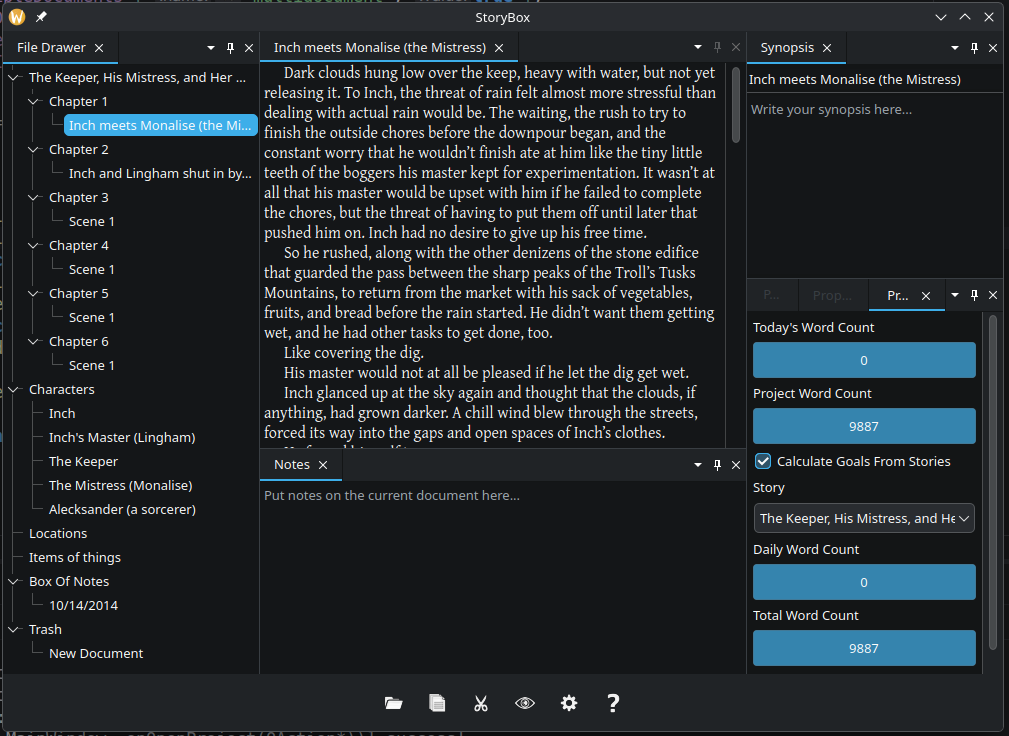
There’s no date set, yet. But I do have a screenshot: